What are you looking for?
Search

Peptide Synthesis
ALL ARTICLES AND PRODUCT INFORMATION PROVIDED ON THIS WEBSITE ARE SOLELY FOR INFORMATION DISSEMINATION AND EDUCATIONAL PURPOSES.
The products provided on this website are intended exclusively for in vitro research. In vitro research (Latin: *in glass*, meaning in glassware) is conducted outside the human body. These products are not pharmaceuticals, have not been approved by the U.S. Food and Drug Administration (FDA), and must not be used to prevent, treat, or cure any medical condition, disease, or ailment. It is strictly prohibited by law to introduce these products into the human or animal body in any form.
Core Definition of Peptide Synthesis
|
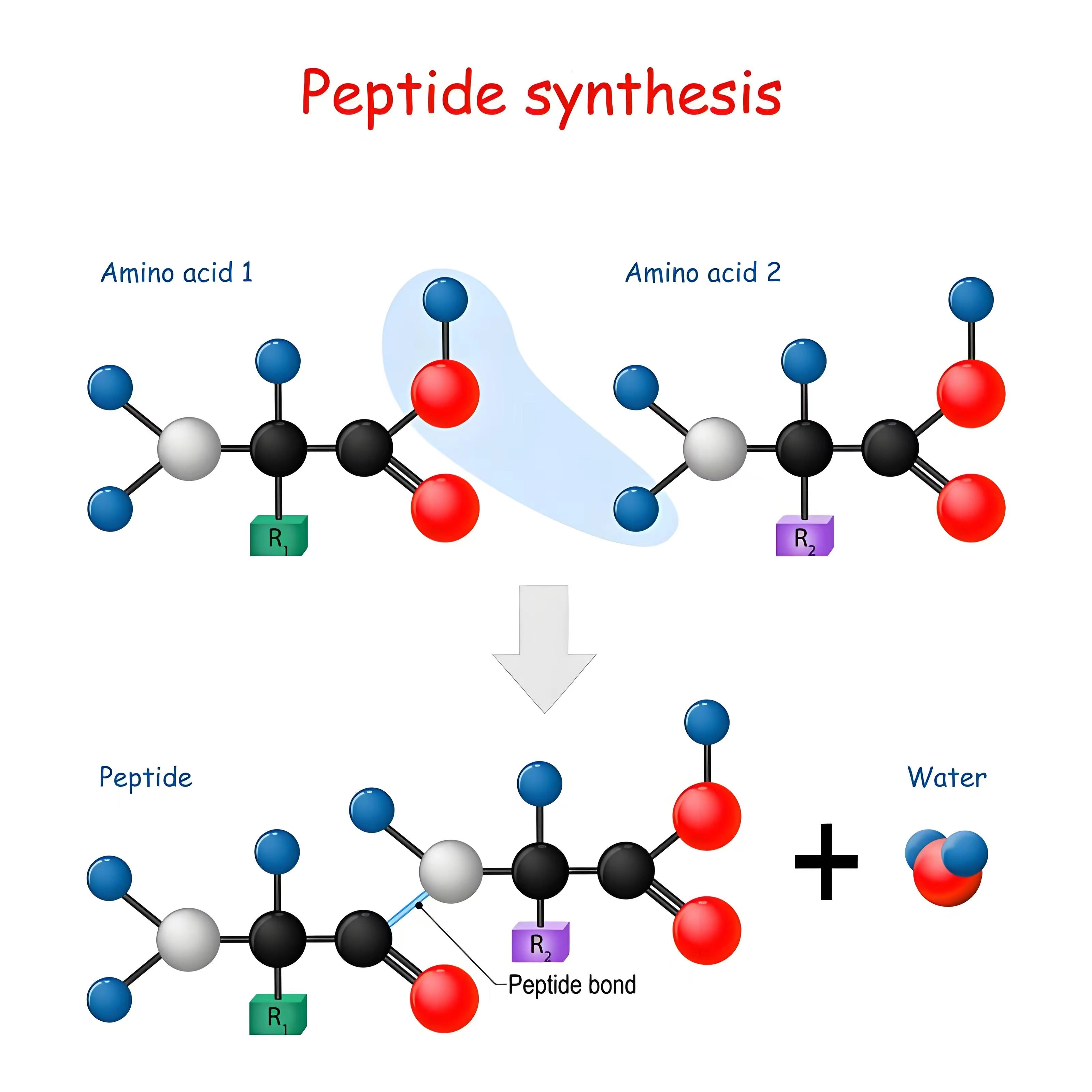
Peptide synthesis refers to the process of constructing amino acid sequences and forming amide bonds (i.e., peptide bonds) through chemical or biological means, essentially enabling the artificial construction of oligopeptide or polypeptide molecules with specific biological functions. As a critical branch of bioorganic chemistry, this technology focuses on the selective activation of amino acid monomers, directional conjugation, and precise control of sequence assembly, spanning the full spectrum from milligram-scale laboratory preparation to kilogram-scale industrial production. Based on divergent synthetic strategies, it is classified into biosynthetic methods relying on biological systems and chemical synthesis methods grounded in organic synthesis principles. Among these, solid-phase synthesis has emerged as the mainstream approach for preparing polypeptide drugs and research-grade peptides due to its high efficiency and potential for automation. |
 |
Molecular Mechanism of Peptide Synthesis
|
Chemical synthesis of peptide chains follows a C-terminal to N-terminal construction logic. Take solid-phase synthesis as an example: the core steps involve first covalently anchoring the carboxyl group of the starting amino acid to an insoluble resin carrier, blocking side reactions through the introduction of N-terminal protecting groups, sequentially deprotecting the N-terminal, and then coupling with activated amino acid derivatives to form new peptide bonds. This process requires precise control over the orthogonality of side-chain protecting groups to avoid nonspecific reactions between functional groups. After sequence assembly, the resin is cleaved under strong acidic or basic conditions, simultaneously removing side-chain protecting groups to obtain the crude peptide product. The biosynthetic pathway, by contrast, relies on ribosomal or non-ribosomal synthetase systems, achieving biosynthesis of natural peptides through mRNA template-mediated or enzyme-catalytic domain assembly. Its advantage lies in the capability to synthesize ultra-long peptide chains and complexly modified natural products. |
 |
Key Technologies in Peptide Synthesis Processes
Optimization of peptide synthesis processes focuses on reaction efficiency, sequence fidelity, and scalability. In chemical synthesis, critical factors for enhancing coupling efficiency and reducing epimerization include the selection of condensation reagents, modulation of solvent polarity, and precise control of reaction temperature. To address the common aggregation challenges in long peptide synthesis, auxiliary solvents such as HFIP may be introduced, or a segmental synthesis-ligation strategy employed. Purification relies on techniques such as reverse-phase high-performance liquid chromatography (RP-HPLC) and gel filtration chromatography, with structural confirmation achieved via mass spectrometry (MS) and nuclear magnetic resonance (NMR). Quality control systems encompass chiral purity testing of amino acids, peptide content determination, and impurity profile analysis to ensure products meet pharmaceutical or research-grade standards. For biosynthetic processes, key efforts lie in engineered modification of host cells, improving target peptide expression and solubility through codon optimization and secretion expression system construction, while integrating downstream separation and purification technologies for industrial production.
Multidimensional Value and Applications of Synthetic Peptides
Synthetic peptides play irreplaceable roles in biomedicine, materials science, and fundamental research. In the pharmaceutical field, polypeptide drugs—characterized by high specificity, low toxicity, and biodegradability—serve as critical therapeutic agents for diseases such as diabetes. In antibody-drug conjugates (ADCs), linker peptides assume the key function of targeted delivery of cytotoxic payloads. In biotechnology, synthetic peptides are utilized as antigen epitopes for antibody development, as ligands for studying receptor-ligand interactions, or as enzyme substrates for dissecting catalytic mechanisms. In materials science, functional peptides can self-assemble into biocompatible materials such as nanofibers and hydrogels, applied in tissue engineering scaffolds or drug delivery vectors. Furthermore, through chemical modifications or incorporation of non-natural amino acids, synthetic peptides can mimic functional domains of natural proteins, providing ideal models for studying protein structure-function relationships and advancing frontiers in precision medicine and chemical biology.