What are you looking for?
Search

Cardiogen: Application in Cardiovascular Health Maintenance
ALL ARTICLES AND PRODUCT INFORMATION PROVIDED ON THIS WEBSITE ARE SOLELY FOR INFORMATION DISSEMINATION AND EDUCATIONAL PURPOSES.
The products provided on this website are intended exclusively for in vitro research. In vitro research (Latin: *in glass*, meaning in glassware) is conducted outside the human body. These products are not pharmaceuticals, have not been approved by the U.S. Food and Drug Administration (FDA), and must not be used to prevent, treat, or cure any medical condition, disease, or ailment. It is strictly prohibited by law to introduce these products into the human or animal body in any form.
Overview
Cardiogen, a substance of significant interest in the field of cardiovascular health maintenance, has a source and nature that are crucial to understanding its role in cardiovascular health maintenance. It interacts with specific targets within the cardiovascular system, thereby exerting its health-maintaining effects on the cardiovascular system.

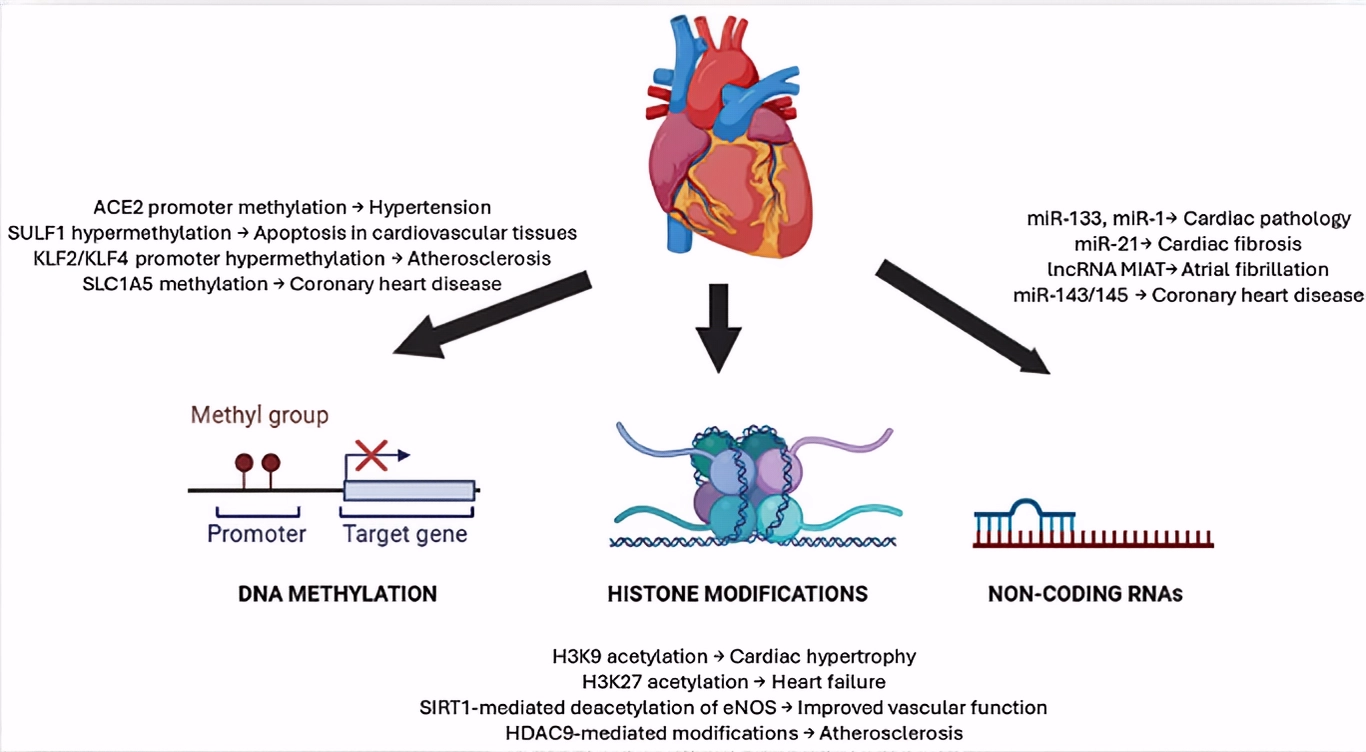
Figure 1. Epigenetic mechanisms in cardiovascular disorders. The heart (center) connects to three major epigenetic regulatory mechanisms influencing cardiovascular pathophysiology.
Effects
Effects on the heart
Regulation of heart rate: Cardiogen can precisely regulate the heart's rhythm, keeping the heart rate within the normal range. Under stress conditions, such as when the body is stimulated by stress hormones like adrenaline, the heart may experience tachycardia. Cardiogen effectively compensates for the stress effects of adrenaline on the heart, helping to lower the heart rate to normal control values while reducing the occurrence of arrhythmias, thereby maintaining normal cardiac pumping function and ensuring adequate blood supply to the entire body.
Promoting myocardial regeneration: Following cardiac diseases such as myocardial infarction, myocardial tissue is damaged. Cardiogen has a significant role in promoting myocardial regeneration by inducing endogenous mesenchymal stem cells (MSCs) to differentiate into cardiomyocytes, thereby repairing damaged myocardial tissue. By stimulating relevant signaling pathways—key pathways involved in embryonic heart induction and angiogenesis—it promotes the regeneration and proliferation of cardiomyocytes, thereby improving cardiac function and enhancing the heart's contractile and diastolic capabilities.
Effects on blood vessels
Improving vascular endothelial function: Vascular endothelial cells are crucial for maintaining normal physiological functions of blood vessels. Cardiogen promotes the health of vascular endothelial cells and enhances their ability to secrete vasodilatory substances such as nitric oxide. Nitric oxide relaxes vascular smooth muscle, thereby dilating blood vessels, reducing vascular resistance, improving blood circulation, and lowering the risk of cardiovascular diseases.
Inhibiting vascular inflammation: Inflammatory responses play a significant role in the development of vascular diseases such as atherosclerosis. Cardiogen can suppress inflammatory responses within the vascular wall, reducing the infiltration of inflammatory cells and the release of inflammatory factors. By inhibiting inflammatory cascades, it alleviates damage to the vascular wall, helping to maintain normal vascular structure and function and prevent vascular narrowing and blockages.
Applications
Myocardial infarction treatment: For patients with myocardial infarction, early intervention with Cardiogen after the onset of the disease can promote myocardial regeneration and repair, reduce the infarct area, and improve cardiac function. Administration can be via oral or injection routes, with specific administration routes and doses adjusted individually based on the patient's condition and physical status. Clinical studies have shown that patients with myocardial infarction who receive Cardiogen treatment exhibit significant improvements in cardiac function indicators such as ejection fraction, thereby enhancing their quality of life and survival rates.
Arrhythmia treatment: Cardiogen can regulate heart rate and stabilize arrhythmia for various types of arrhythmia. For patients with mild arrhythmia, treatment with Cardiogen can reduce the frequency and severity of arrhythmia episodes, avoiding or reducing the side effects associated with traditional antiarrhythmic drugs. In clinical practice, doctors will use Cardiogen appropriately based on the patient's electrocardiogram monitoring results and symptom manifestations.
Related Research
Animal Experiment Studies: Multiple animal experiments have conducted in-depth investigations into Cardiogen's cardiovascular protective effects. In rat experiments, after establishing a myocardial infarction model and administering Cardiogen intervention, significant myocardial regeneration was observed in the myocardial infarction area, with cardiac function indicators such as left ventricular ejection fraction significantly improved. Additionally, in vascular-related experiments, it was observed that Cardiogen could inhibit vascular endothelial proliferation and reduce the formation of atherosclerotic plaques, indicating its good protective effects on blood vessels. These animal experiments provide important theoretical foundations and experimental evidence for the application of Cardiogen in cardiovascular and cerebrovascular health maintenance.
Clinical Studies: Some small-scale clinical studies have also conducted preliminary assessments of the safety and efficacy of Cardiogen. In studies targeting patients with arrhythmia, it was found that after treatment with Cardiogen, patients' arrhythmia symptoms improved significantly, and no severe adverse reactions occurred, demonstrating its potential application value in the treatment of arrhythmia. In clinical studies of myocardial infarction patients, it was observed that patients treated with Cardiogen had better cardiac function recovery than the control group, further confirming its therapeutic effect on myocardial infarction.
Conclusion
In summary, Cardiogen plays an important role in cardiovascular health maintenance. Through its multifaceted effects on the heart and blood vessels, it holds significant application potential in both clinical treatment and daily health maintenance.
Sources
[1] Martínez-Iglesias O, Naidoo V, Carrera I, et al. Natural Bioproducts with Epigenetic Properties for Treating Cardiovascular Disorders[J]. Genes, 2025,16(5},
ARTICLE-NUMBER = {566). DOI:10.3390/genes16050566.
[2] Lin X, Peng P, Cheng L, et al. A natural compound induced cardiogenic differentiation of endogenous MSCs for repair of infarcted heart[J]. Differentiation, 2012,83(1):1-9.DOI:10.1016/j.diff.2011.09.001.
[3] Cheng L, Chen H, Yao X, et al. A plant-derived remedy for repair of infarcted heart[J]. Plos One, 2009,4(2):e4461.DOI:10.1371/journal.pone.0004461.
Product available for research use only: